How SIEM platforms collect, correlate, and analyze data
SIEM platforms help you make sense of large volumes of security data by collecting activity from across your environment, standardizing that data, and analyzing relationships between events.
At a conceptual level, SIEM platforms follow a consistent pipeline to transform raw security data into actionable insight. This process brings together activity from endpoints, networks, and cloud services, applies core SIEM functions, and surfaces alerts to support investigation and response.
This article builds on the general SIEM concepts introduced in What is a SIEM? and Understanding key features and components of SIEM solutions, and focuses on how security data moves through a SIEM pipeline.
High‑level SIEM data flow
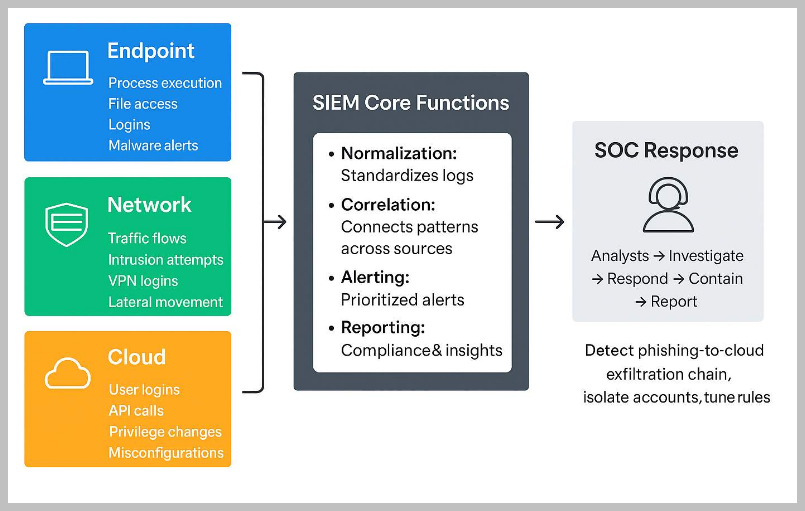
A high‑level view of how SIEM platforms bring together endpoint, network, and cloud activity, apply core SIEM functions, and surface alerts to support investigation and response.
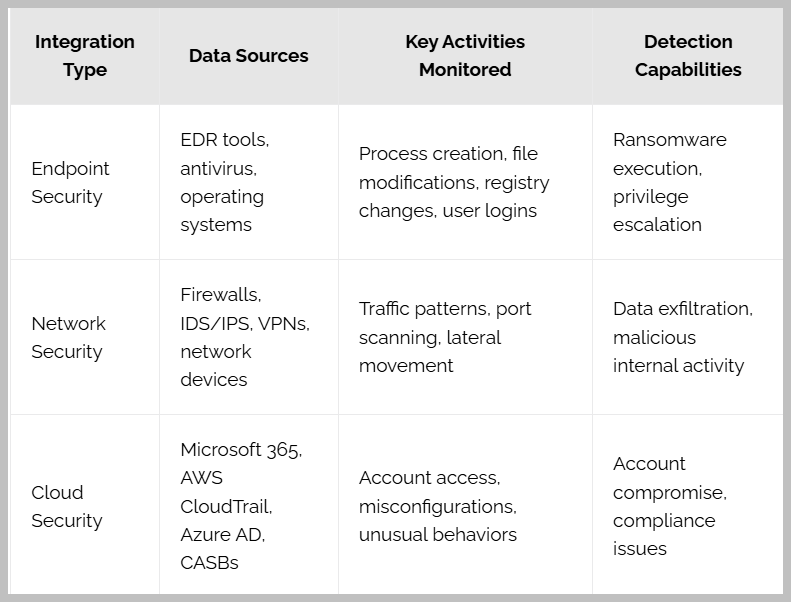
Example of common security data sources and activities analyzed by SIEM platforms across endpoint, network, and cloud environments.
(The items shown are examples and may vary by environment and SIEM platform.)
Collecting security data from multiple sources
The first step in SIEM analysis is data collection.
SIEM platforms ingest security‑relevant data from many parts of an organization’s environment, including:
-
Endpoints and servers
-
Network and infrastructure devices
-
Identity and access systems
-
Applications and cloud services
Each source produces logs or events that describe activity such as logins, configuration changes, process execution, API calls, or network connections.
By centralizing this data, a SIEM allows you to review security activity in context, rather than examining isolated records across multiple tools.
Standardizing data through normalization
Different systems record activity in different formats and use different field names. To analyze this data consistently, SIEM platforms normalize incoming data.
Normalization typically involves:
-
Mapping vendor‑specific fields to common attributes such as user, device, IP address, and timestamp
-
Converting data into a standardized structure or schema
-
Applying consistent terminology across sources
This standardization allows SIEM platforms to compare and analyze activity from systems that would otherwise be difficult to evaluate together.
Correlating related activity
Correlation is the process of connecting events that are related but originate from different sources. Rather than evaluating each event independently, SIEM platforms analyze relationships across normalized data.
Correlation can reveal:
-
Sequences of activity that indicate attack behavior
-
Actions performed by the same user or device across systems
-
Patterns that span endpoints, network infrastructure, and cloud services
By correlating related signals, SIEM platforms reduce noise and highlight activity that is more likely to represent meaningful security risk.
Analyzing data to identify risk
Once data is collected and correlated, SIEM platforms analyze activity to determine whether it may represent a threat, misuse, or policy violation.
Analysis methods may include:
-
Rule‑based detection
-
Behavioral or anomaly‑based analysis
-
Threat intelligence matching
These techniques help SIEM platforms prioritize activity that warrants investigation while filtering out low‑risk or expected behavior.
The outcome of this analysis is activity that can be investigated in context, rather than isolated events reviewed individually.
Generating alerts and insights
When analyzed activity meets defined conditions or thresholds, SIEM platforms generate alerts. Alerts serve as entry points for investigation rather than raw log messages.
Effective alerts typically include:
-
Context about related events
-
Information about affected users, devices, or services
-
Indicators that help assess severity or impact
This approach helps security teams focus on understanding what happened and deciding how to respond, rather than manually reconstructing events from individual logs.
Supporting investigation and response
By combining collection, normalization, correlation, and analysis, SIEM platforms provide a foundation for investigation and response.
Security teams can use SIEM data to:
-
Trace activity across systems and timelines
-
Understand how events are connected
-
Support incident response and remediation
-
Generate reports for compliance, audit, or forensic purposes
A SIEM does not replace security controls or response processes. Instead, it provides the visibility and context needed to support informed decision‑making.
Summary
SIEM platforms collect security data from across the environment, standardize that data, and analyze relationships between events to identify activity that may represent risk.
This pipeline explains how SIEM platforms move from raw security data to alerts that support investigation and decision‑making.
Earlier articles describe what a SIEM is and the core components involved. Later sections explain how this pipeline is implemented in Kaseya SIEM and how SIEM data is used during investigation and response.
Related articles
-
Common SIEM terminology: The shared vocabulary used across SIEM platforms and throughout this documentation
-
How Kaseya SIEM works: See how this data pipeline is implemented and expressed in Kaseya SIEM
-
Using Kaseya SIEM: Learn how SIEM data is used during investigation and day‑to‑day operations


